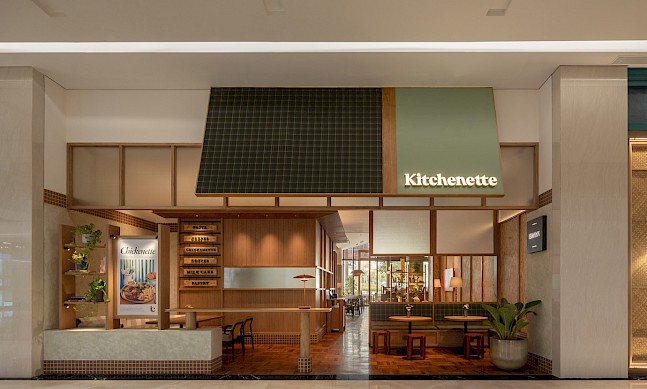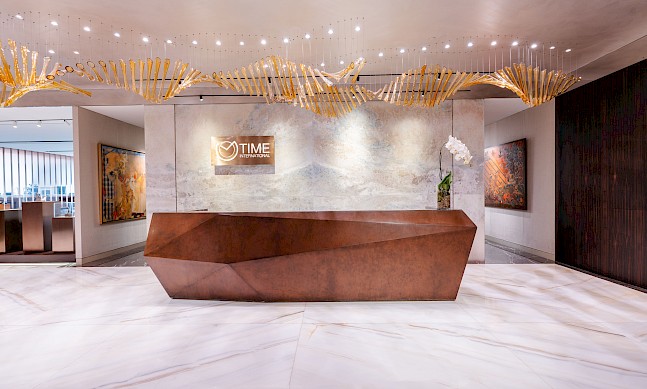








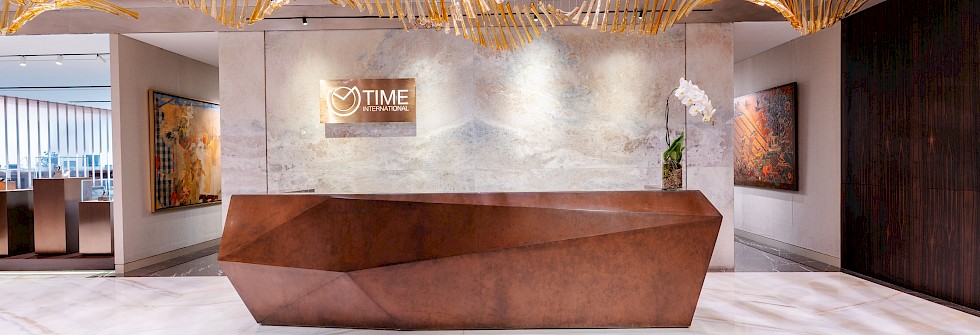
Time International holds exclusive retailing rights to more than 50 of the world’s most renowned luxury lifestyle brands, operating a network of more than 80 stores across Indonesia.
Customer service is the foundation of Time International, with the company’s development fueled by a substandard luxury shopping encounter faced by President and CEO Irwan Mussry. “It was a dream product, and that experience stayed with me,” Mussry says, explaining how it prompted him to build a company to better represent global brands. “From the beginning, integrity was my focus; the brand had to come first, not me.”
That ethos is reflected in the company’s current standing as Indonesia’s curator and cultivator of world-class luxury brands. Family owned and operated, Time International’s operations span both multi-brand retail stores and mono-brand boutiques for leading names that include Chanel, Cartier, Chopard, and many more. The company also operates the largest service centers in Jakarta, Time Care and Watch Care, equipped with cutting-edge technology to provide the highest levels of aftercare across all its brands.
Throughout the company’s growth, customer focus has remained the priority. “We are fully customer-centric, providing not only full services but the right services, ensuring that every interaction reflects a deep respect for our customers,” explains Mussry. That continues today, with the business expanding its digital platforms to include official online stores and consultation services via WhatsApp. “Service excellence was and will always be our goal, supported by strong functions around it,” Mussry adds.
As Indonesia’s market matures, Time International is entering a period of concentrated investment in its domestic operations. Over the next two years, the company is upgrading its boutiques and expanding store formats to further enhance the customer experience. “Whether it is multi-brand or mono-brand, the goal is to create experiences that bring customers closer to their aspirations,” says Mussry.
This strategy reflects the changing nature of Indonesia’s growing luxury market, with consumer expectations now shaped by international service standards. “The market is only at the beginning of its potential,” Mussry continues. Capitalizing on that potential means delivering a retail experience that meets those expectations while remaining authentically Indonesian. “Understanding consumer behavior here means being both global and local – global in standards, local in language, culture, and storytelling.”
This is complemented by significant investment in digital infrastructure, which includes using data analytics to better understand customer movements in-store and inform optimized layouts. Alongside this, the company is integrating AI tools and building a dedicated team to leverage its potential. “Our goal is to transition to fully tech-based management within three years,” Mussry notes.
That ambition is underpinned by a long-standing commitment to talent development. The company has implemented structured programs to attract and retain top graduates, offering them real-world leadership experience from the outset. By integrating data-led insight with long-term human capital development, Time International is positioned to take Indonesia’s luxury market to new heights. “Representing a brand requires honoring its history, heritage, and identity,” Mussry says. “With growth, challenges can distract, but staying focused on values and execution is vital.”
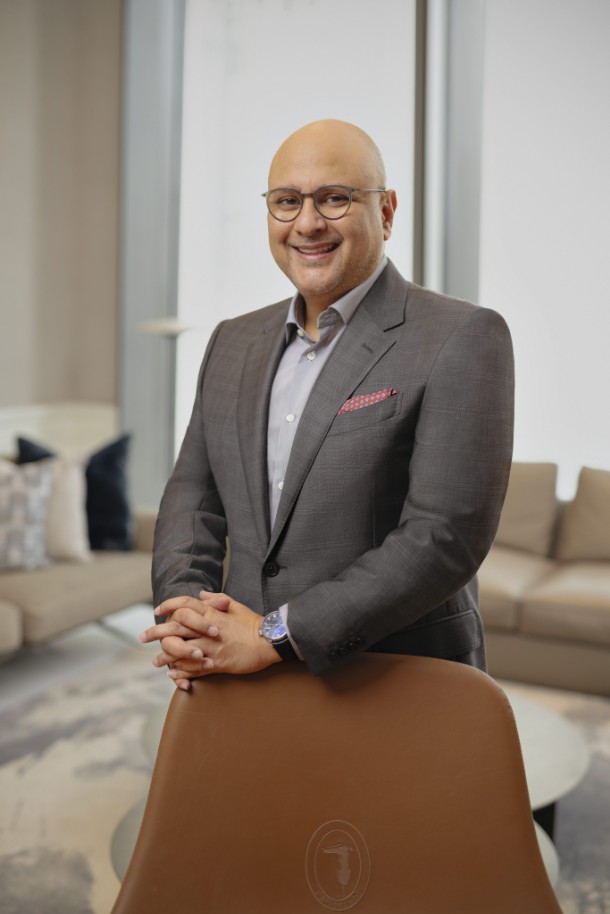
“Representing a brand requires honoring its history, heritage, and identity.”
IRWAN DANNY MUSSRY, President & CEO, Time International
Post ThisRead selected extracts from the interview below.
Q: How do you view the size and future potential of Indonesia’s luxury market?
Indonesia is highly dynamic, with strong domestic consumption and a young, emerging population. A strong domestic base provides longevity, while tourism adds another layer. Indonesian consumers now expect the same service standards they would receive in the U.S. or Europe.
Q: Rather than aggressively expanding your brand portfolio, you are reinvesting in existing operations. Why is that a priority now?
Historically, and I say this with humility, we have not sought out brands much. A lot of the time, brands have come to us as a result of our consistent performance in the market. Our main focus is on building deeper rather than wider in the market. By deeper, I mean enhancing every aspect of the store environment. Over the next two years we are reinvesting in our existing portfolio, upgrading and expanding boutiques to give consumers more space and better experiences.
Q: Technology and AI are increasingly shaping retail. How do they fit into a luxury business built on human interaction?
Data has become a central part of decision-making, balanced with the human factor, staying close to the market, and understanding its dynamics. We are investing heavily in technology and AI and have built a major team dedicated to it.
Our goal is to transition to fully tech-based management within three years. This begins with a deep understanding of consumer behavior. For example, we analyze store layouts, track which areas customers occupy most during the day, then adjust brand placement accordingly. We work closely with our principals, who share global data and insights, to refine these strategies.
Q: Talent development appears to be as strategic as retail investment. How has that evolved as the company scaled?
From the beginning, people were the priority, they would do the work with me. As we grew, it was obvious that doubling or tripling the scale meant bringing in the right people. We have made major investments in learning and development. We run scholarship programs, hire top graduates, and bring them in without contracts. They work for nine months as managers-in-training, then decide whether to stay or move on. Many have been with us for 20–25 years. Some started their first jobs with me and are now in senior roles.
Q: How would you frame Indonesia’s opportunity today for global readers, and how does your own journey reflect that evolution?
Indonesia is a young, dynamic, and still-emerging market with vast opportunities. Coming early with the right product allows you to ride the wave of growth. I started with four or five people; today, we are in the thousands. With growth, challenges can distract, but staying focused on values and execution is vital. Experience now matters more than ever. Building relationships requires honesty and being fully present in the moment. I believe we are still at the beginning.