







Steelmaking giant CSN is a vertically integrated conglomerate spanning steel production, logistics, mining, cement and energy. Already Brazil’s second-largest iron ore exporter, the group is now developing infrastructure as a core business, with the Transnordestina railway creating a new corridor between Brazil’s agricultural interior and Asian markets. In this interview, Tufi Daher Filho, Executive Director of Infrastructure and Logistics, outlines CSN’s strategy and the new railway’s potential to strengthen trade with China.
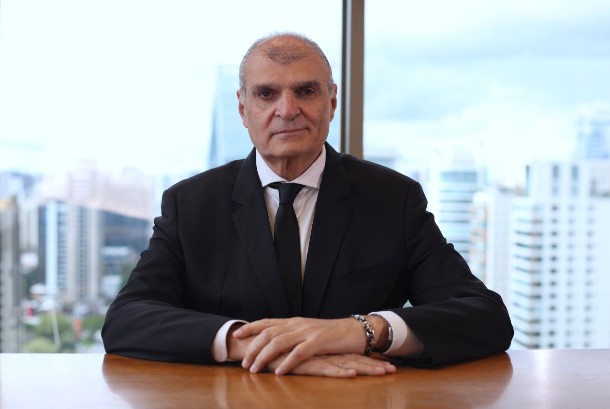
“CSN plays a fundamental role in Brazil’s relationship with China”
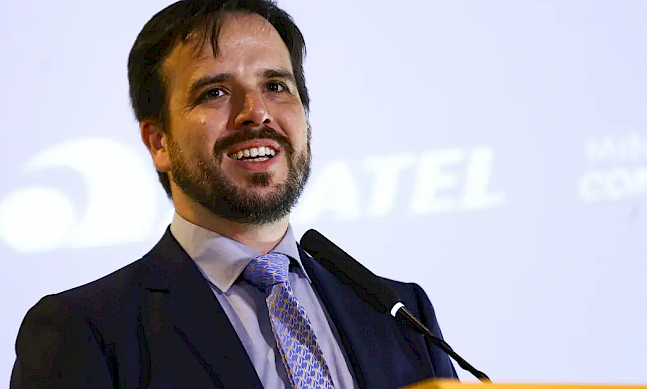
Tufi Daher Filho Executive Director of Infrastructure and Logistics, CSN
Post ThisQ: How is Transnordestina progressing towards full commercial operation?
Tufi Daher Filho, Executive Director of Infrastructure and Logistics, CSN: The moment we are living now is the finalisation phase. If you look at it, it was divided into two stages. Phase 1 has a little over 1,000 kilometres, almost 1,060 kilometres, and Phase 2 is an additional 144 kilometres in the Piauí region.
We have already carried out two tests, and in February alone we expect three more shipments, so we are now calling it the domestic market. The domestic market has less volume potential than exports, but it has very important reach. When we talk about soybeans, corn, soybean meal, sorghum, millet and other cargo such as gypsum, agricultural limestone and fuels, all of that is on our agenda. We already have three contracts signed.
It is fundamental that we show the market that Transnordestina has levelled up: it has truly entered a new phase. It is moving into what we call the pre-operational stage, as it moves towards full operation, and by the end of 2027 we will be fully operational, together with the P100 port and NELOG, our port company. We will begin port construction in the first half of 2026, with completion expected alongside the end of Phase 1 of Transnordestina, in late 2027.
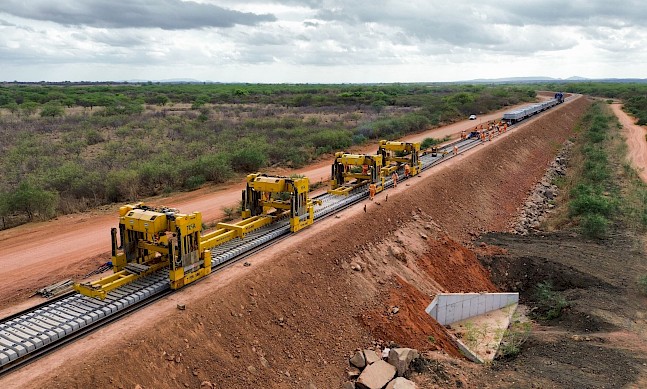
It is a key milestone. When we say we have 700–750 kilometres ready, those are only the main lines and only what we call Phase 1. But if you include the yards — every 40 kilometres you have around two and a half kilometres of yards — and the 200 kilometres completed in Pernambuco’s triangle, we already have more than a thousand kilometres of railway built, which is very significant.
I have no doubt it is the largest infrastructure project currently underway in the country. More than 5,500 people are working full-time, and the level of job creation in the Northeast is enormous. I just came back from there this week. It was interesting because we saw the start of one lot from the very beginning, from vegetation clearing to the dry groundwork. Then we visited lots 4 and 5, which are at the superstructure finishing stage. There is a huge journey from starting the works and building bridges, to what I call the ‘ironwork’ phase, laying sleepers, rails, ballast, fastening everything and preparing it for operation.
So yes, Transnordestina has truly changed level, and our main focus now is to finish construction while simultaneously bringing in new transport contracts.
Q: Where could Chinese suppliers support Transnordestina’s next phase?
TDF: The first big opportunity we had was rail purchases. We bought rails from Angang — almost 40,000 tonnes for the project’s completion — which are arriving now in February at the Port of Pecém. Naturally, we are already evaluating other inputs. You mentioned locomotives and wagons. We made a small wagon purchase in Brazil, but Transnordestina will require thousands of wagons during its cargo ramp-up. So I clearly see the possibility of strategic partnerships to bring Chinese equipment and technology to Brazil. That is definitely on our radar.
Q: How will this corridor strengthen trade and food security?
TDF: Infrastructure at CSN was always important, but mostly internally. Even the market could not see the full logistics and infrastructure potential within the group, because we always focused on mining, steel, cement, energy and the logistics behind them. But we have extremely valuable and strategic assets.
Today it has become one of CSN’s biggest businesses and bets, along with our port assets. We have a stake in MRS; and we acquired Tora, a road freight company in Minas Gerais. When you combine all these assets, they have the potential to become CSN’s biggest business in a few years.
Regarding food security, when you look at Transnordestina’s location combined with the Port of Pecém, passing through the Panama Canal cuts access time to Asia by seven or eight days. Imagine what that means for logistics. Strategically, it makes total sense to have an asset there, with the shortest transit time to Asia. That reduces costs across the entire system and makes every sector more competitive. In addition, we are not only thinking about commodities like iron ore or soy; this opens opportunities for containers and finished products too.
Q: How is CSN structuring infrastructure as a business?
TDF: As a business unit, yes. We have already communicated to the market that we are structuring CSN Infrastructure. It will be born with two clusters. The Southeast cluster is already operating, including our MRS stake, the CPT ports, and Tora. That cluster is ready and we are preparing to launch a strategic market bid soon.
Once Transnordestina and NELOG are completed by the end of 2027, we will develop the Northeast assets starting in 2027–2028. This will add a lot of value to CSN, and together these two clusters have the potential to become the group’s largest business in the future.
Q: Will the new port development seek outside investors?
TDF: Absolutely. We have already begun discussions for equipment procurement, access routes are being arranged, the land is defined, contracts with P100 are in place. Now we are going to the market to acquire equipment, silos and infrastructure; we want fertilisers, containers and mining operations there. It is not just a beautiful project, it can generate very important results for CSN.
Q: How will Transnordestina benefit communities and advance sustainability?
TDF: Transnordestina is a world-class railway, comparable in Brazil only to Carajás in terms of infrastructure quality, with 1% gradients, built for high performance. When you install something like this across three northeastern states, you attract a huge number of companies, and that is what is happening now. Every day I receive invitations to present the project, to discuss where industries or distribution centres could be installed.
We are already seeing the effects. Each construction lot covers about 50 kilometres and impacts three or four small towns. Commerce, hotels, supermarkets, petrol stations, pharmacies, everything moves around the project. Imagine when industries begin to settle there. Even without actively seeking them, we already foresee at least eight to ten terminals along the railway. Of course, we will choose projects that perform well and benefit both business and communities, always prioritising carbon-reduction goals in construction and future operations.
Q: How does government alignment strengthen confidence among investors?
TDF: Look at what happened with Transnordestina: there are 27 direct stakeholders involved. I am not even counting municipalities, I am talking about ministries, funds, regulators, environmental licensing bodies.
Today all 27 are aligned, which is why the project is moving faster. Securing funding is the first step. Brazilian engineering already has the know-how to deliver projects of this scale, although we still need more advanced equipment and technology. If you combine Brazilian engineering with foreign technology and equipment, you create enormous value, strengthen local expertise and generate opportunity for everyone involved.
Brazil today is a hub of opportunity in the world. And this alignment between federal and state governments around infrastructure, not only Transnordestina, is being treated as state policy rather than government policy. State policy transcends administrations; railways are long-term investments.
Q: Why should Chinese investors choose Brazil and CSN?
TDF: CSN’s role in this national context is extremely important because it is highly diversified. We have not put all our eggs in one basket. Even though the name is Companhia Siderúrgica Nacional, today the group is the country’s second-largest mining company and second-largest cement producer. We are investing heavily in clean energy, and now logistics has become a core pillar: ports, road freight, railways.
When I say railways, I do not mean only Transnordestina. We also operate FTL, an older network across Ceará, Piauí and Maranhão — also about 1,200 kilometres — currently undergoing concession renewal and modernisation. Together with our port assets and MRS participation, CSN plays a fundamental role in Brazil’s relationship with China. We already export most of our iron ore to China, and we are expanding into logistics and agribusiness, acquiring land around Transnordestina to help drive exports through the Northeast corridor.