







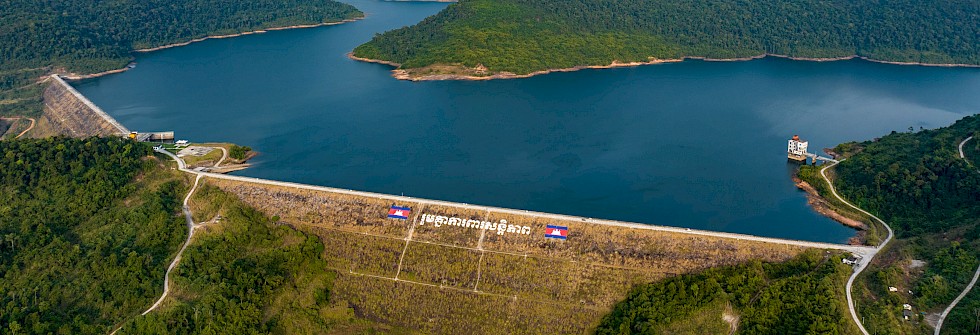
The Stung Tatay Hydropower Project, a flagship green energy project developed in partnership with China, produces more than 1 billion kWh of renewable power annually and has become one of Cambodia’s most significant sources of domestic clean electricity. Located on the Tatay River in Koh Kong province, the project includes an 882-metre main dam and a 665-metre auxiliary dam, and has generated more than 10 billion kWh since entering operation in 2015. As Cambodia looks to cut fossil fuel dependence, strengthen energy security and move towards carbon neutrality by 2050, hydropower is taking on a more strategic role within the national energy mix. In this interview, Deputy General Manager Wang Jue discusses the project’s impact.
“Our project has cumulatively reduced over 5.6 million tons of CO2 emissions and strongly supports Cambodia’s clean energy development.”
Wang Jue Deputy General Manager
Post ThisQ: How did the Stung Tatay project begin?
Wang Jue, Deputy General Manager: Our Tatay Hydropower Project stands as a landmark of high-quality, green, low-carbon energy cooperation between China and Cambodia. It aligns with both countries' strategic pursuit of clean energy and sustainable development. Our project aims to improve local livelihoods while contributing to Cambodia’s socio-economic progress. Since construction started in June 2010, we have connected multiple generating units to Cambodia’s power grid ahead of schedule, which was praised by former Prime Minister Hun Sen. We are committed to generating economic, social and environmental value while prioritizing environmental protection and ecosystem development. We have also actively participated in international carbon neutrality efforts, including carbon asset management through partnerships in the EU market, achieving significant certified emission reductions.
Q: Why is Tatay central to Cambodia’s energy transition?
WJ: Cambodia has turned to domestic renewable and green energy sources to replace expensive imported fossil fuels. Our project addresses a critical weakness in Cambodia’s energy structure and plays a vital role in moving the country toward energy self-sufficiency. We contribute significantly to national energy security by supporting the establishment of an independent, controllable domestic energy supply system. Our cooperation with China represents a win-win strategy grounded in mutual benefits and shared development. Since operation, Tatay Hydropower has maintained electricity output 20% above design capacity for 10 years and generated over 10 billion kWh of clean, high-quality electricity. Our project has cumulatively reduced over 5.6 million tons of CO2 emissions and strongly supports Cambodia’s clean energy development.
Q: What social and economic impact has the project had?
WJ: Our project contributes by providing affordable and reliable electricity access. We have reduced electricity prices significantly—from about 4000 riel ($0.15) per kWh, which is roughly one-seventh of previous costs—while maintaining a stable supply of clean energy. This affordability supports economic growth and public welfare improvement across Cambodia. We have jointly invested in building nearby power transmission facilities and worked with the Cambodian government to support water treatment systems, flood warning systems and fruit tree irrigation in local districts. These efforts have enhanced drinking water safety for schools and addressed irrigation for over 40 hectares of orchards during dry seasons. We have also built roads and bridges to improve local transportation and organized tree planting, wildlife protection and fish breeding activities to protect biodiversity and aquatic ecosystems. To date, we have planted over 4,000 tree saplings and released more than 300,000 juvenile fish.
Thanks to the improved river environment, local communities have developed stairs, restaurants, resorts and tourism is thriving. Visitors can take boat tours through the river and rainforest, creating new income sources for residents and significantly improving living standards. We are committed to respecting local culture, green development and corporate social responsibility.
We are deeply committed to advancing our localization strategy by integrating local talent into our operations, organizational structure and management decision-making. We aim to create as many employment opportunities as possible for local residents. Through the development of the Tatay Hydropower project, tens of thousands of jobs have already been created for the surrounding community.
We actively engage with local society through cultural exchange initiatives, including establishing knowledge-sharing centers and a center for Chinese language and professional skills at the hydropower station. These centers cultivate local hydropower professionals who are linguistically capable, culturally aware and technically skilled. Our goal is to provide integrated support through talent policies and resources to ensure the team’s long-term and sustainable local development.
Q: What makes Tatay a technological benchmark?
WJ: We use peak shaving and staggered water release to enhance downstream flood prevention and disaster resilience. With sufficient electricity supply, local residents have expanded their economy, including fruit cultivation and agricultural processing. To assist downstream communities during flood season, we installed equipment like warning signs, water gauges and surveillance systems along riverbanks to ensure safety for residents and their daily life.
We have developed a comprehensive "three-prong flood defense system." First, a precise monitoring and early warning system: this includes an independently developed hydrological monitoring network with 11 rainfall and water-level stations, providing early alerts for heavy rainfall.
Secondly, a refined dispatch and decision system. This system forecasts flood risks early and maintains 24-hour emergency communication lines with towns and villages to ensure timely and multi-channel transmission of commands.
Thirdly, efficient operation and maintenance. We ensure all generating units are well maintained before flood seasons to guarantee stable operation during rains.
Additionally, we are advancing digital transformation by implementing automated monitoring stations to collect data on flow rates, water levels, water quality and equipment safety. We also use advanced digital twin technology to create a visualized platform that improves operational data analysis. These digital innovations lay a strong foundation for smart, accurate and sustainable hydropower operations.
Q: How do you see Cambodia’s renewable energy future?
WJ: We have an exciting new hydropower project scheduled to come online soon, which will further reduce carbon emissions by an estimated 5.25 to 6 million tons and generate approximately 10 billion kWh of clean electricity. This expansion will deepen our impact on sustainable energy, local employment and community development.
The project is almost finished, and we plan to start power generation around November 2026, as agreed with the Cambodian government. We aim to take full advantage of the upcoming rainy season to begin operations as early as possible.
Cambodia’s traditional fossil fuels and imported electricity are insufficient to meet its long-term energy demands. Renewable energy is the inevitable choice moving forward. We predict Cambodia’s energy structure will increasingly rely on hydropower as the mainstay, supported by wind, solar and energy storage solutions.
Several hydropower projects are already operational or under construction, and the government promotes integrated solutions that combine wind, solar and storage technologies to address electricity integration challenges. The future of Cambodia’s renewable energy development lies in strengthening international cooperation, improving policy and market mechanisms, and promoting localized technological innovation to ensure stable and sustainable growth in the energy sector.
Q: Where are the biggest opportunities for foreign investors?
WJ: Global industrial restructuring and Cambodia’s pursuit of carbon neutrality have accelerated demand for green infrastructure. The Cambodian government strongly supports investment in clean energy projects. Foreign investors have opportunities to focus on high-potential regions or high-value sectors, especially renewable energy and green infrastructure, where long-term development offers sustainable returns.
Currently, besides the successfully operating Tatay Hydropower station, we are constructing an upstream hydropower station called the "Upper Tatay Hydropower Project." This new project is expected to start power generation in 2026 and will provide approximately 530 million kWh of clean energy annually to Cambodia, in addition to the existing output.
Our story reflects Cambodia’s aspirations for a brighter future and a strong commitment to sustainable development. We see every kilowatt-hour generated as not just power but as a symbol of hope, progress and community upliftment.
We look forward to working with partners worldwide to expand this vision, ensuring that our projects contribute meaningfully not only to energy but to local livelihoods, culture and environmental stewardship.
Q: Why should global investors consider Cambodia?
WJ: Cambodia offers democratic opportunities, especially in green and clean energy, which is not only a driver of economic growth but also a vital bridge to environmental responsibility. The Tatay Hydropower project exemplifies how sustainable energy must deliver three core benefits simultaneously: power generation efficiency, ecological harmony and community well-being.
This is not a solo effort; it is a co-creation involving government, enterprises and local communities. The Cambodian government has introduced favorable policies like import tax exemptions, tax-free equipment and land preferences to attract foreign investment.
Investing in Cambodia’s renewable energy sector is an opportunity to secure high-quality assets at relatively low costs and to participate deeply in developing Cambodia’s energy system while sharing in the country’s long-term growth dividends.
We warmly invite everyone to visit Tatay. It’s more than a hydropower project—it’s a place where sustainable development, culture, community and technology come together. Whether exploring our surroundings, learning about renewable energy, or engaging with local communities, visitors can see first-hand how Tatay Hydropower is shaping Cambodia’s green future.