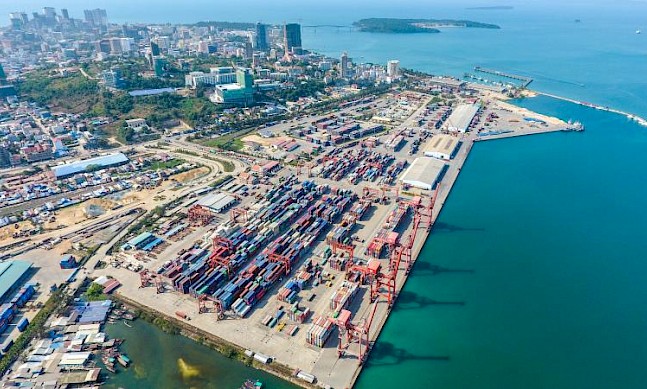








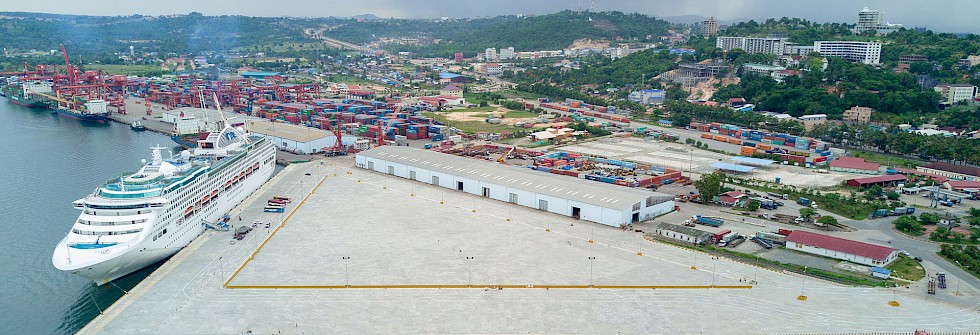
Sihanoukville Autonomous Port is emerging as a more advanced trade and logistics gateway, central to Cambodia’s push to integrate more deeply into global supply chains. A three-phase expansion plan costing less than $1 billion is designed to improve connectivity, lower logistics costs, expand trade and attract foreign capital. That trajectory marks a dramatic shift from three decades ago, when the port handled just 280,000 tons of cargo. Today, volume exceeds 9 million tons, with throughput rising by more than 12 percent annually and the United States now serving as Cambodia’s largest export market. In this interview, Lou Kim Chhun, Chairman and CEO of Sihanoukville outlines the port’s expansion strategy.
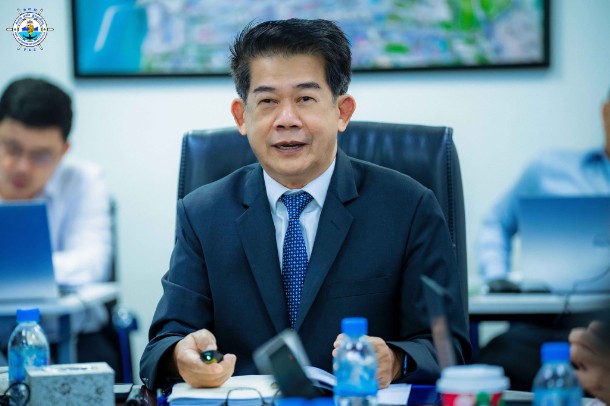
“We are investing under a three-phase plan, totaling less than $1 billion, to enhance connectivity, lower logistics costs, expand trade and attract foreign direct investment.”
Lou Kim Chhun Chairman and CEO
Post ThisQ: How will national transport links strengthen the port?
Lou Kim Chhun, Chairman and CEO: Last year, the Prime Minister visited our port four times, which makes us proud. He sees the port as a key gateway for Cambodia and a point of global connectivity. We welcome all countries, fostering peace and cooperation. The port strengthens trade competitiveness, attracts investment, creates jobs and supports national development, especially by lowering logistics costs. Most costs come from ocean freight, with smaller portions from land transport. Deepening the port reduces freight costs, further boosting competitiveness and economic growth.
We are investing under a three-phase plan, totaling less than $1 billion, to enhance connectivity, lower logistics costs, expand trade and attract foreign direct investment. These investments benefit both Cambodian workers and international investors.
Currently, only about 30% of regional ships call at our port. By 2027, this will rise to 98% in East Asia and extend to the Pacific, including the U.S. and India, enabling direct calls without transshipment, saving time and money. By 2030, Phase III will be complete, allowing ships from Europe and beyond to dock directly, further reducing freight costs and benefiting all, especially Cambodians.
We thank the Japanese government and the Japan International Cooperation Agency for loans supporting the three phases. We also thank the French government and engineers who, inspired by King Norodom Sihanouk, helped establish this port in Sihanoukville as Cambodia’s best location along 400 kilometers of coastline. The United States also contributed by building Road No. 4, the first high-quality road linking Phnom Penh to the port.
Q: What explains the port’s remarkable long-term growth?
LKC: In 1953, after gaining independence, our former king decided to build this port, recognizing the importance of direct sea connectivity for Cambodia. Relying on rivers through Vietnam was limited by shallow drafts and seasonal dredging. The king foresaw that as ships grew larger and drafts deeper, transport costs would fall, making ocean freight essential for national competitiveness.
The port has grown rapidly, and peace has been central to this progress. Cambodia’s history has been marked by centuries of war and hardship. After gaining independence in 1953, the nation enjoyed only 17 years of peace before conflict returned from 1970 to 1998. Now, we have had 26 years of peace, during which the country has transformed.
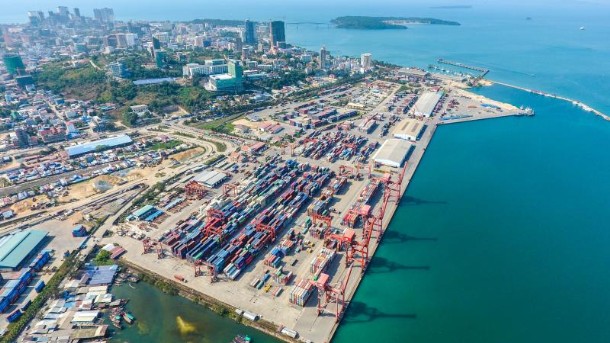
In 1993 and 1994, cargo volume through the port was only about 280,000 tons. Today, it exceeds 9 million tons, with an average annual growth rate above 12% and more than one million containers handled last year. In 2019, before COVID-19, growth was 18%. In 2024, compared to 2023, container throughput rose 29.38%, our highest rate ever. This year, growth may reach another 25%.
We are proud to serve the Cambodian people, but this port is not only for Cambodia. It connects investors and partners worldwide, benefiting everyone who uses it.
Q: What cargo has driven recent volume growth?
LKC: Containers carry products like garments, industrial goods, agricultural produce and construction materials that support Cambodia’s development. Our largest export market is the United States, followed by Europe. We are grateful for their support, which creates jobs and reduces poverty.
All of this is possible because of peace. Peace is vital for Cambodia. Having endured years of war, including the Khmer Rouge era, we understand its value. Cambodia lost nearly three million lives from a population of only seven million, one in every three people. This experience makes us determined never to return to war. We want peace with our neighbors, Thailand, Vietnam and Laos. Conflict brings suffering. Peace allows us to prosper together.
Without peace and political stability, no one invests. Investors avoid unpredictability, just as ordinary people prefer safety when traveling. Before 1998, life was dangerous. Traveling from Sihanoukville to Phnom Penh required escorts, and attacks along the road were common. After 1998, peace returned. By 1999, we could drive safely, even at night. These experiences show why peace is essential for Cambodia’s future.
Q: What will each expansion phase make possible?
LKC: Phase One, funded by a loan from Japan, will deepen the port to 14.5 meters by 2027, allowing 93% of regional ships from East Asia and the Pacific, including Japan, Korea and China, to dock directly. Phase Two, to be completed in 2029, will deepen the port to 16.5 meters, enabling ships from the Indo-Pacific, including the United States and India, to call directly. Phase Three, to be finished in 2030, will reach 17.5 meters, allowing nearly all ships worldwide to dock. Total port capacity will then be 2.6 million TEU per year.
At the Prime Minister’s direction, we are also studying future development through 2050. Growth has consistently exceeded predictions, with cargo rising by 25% this year compared to much lower forecasts. The long-term vision emphasizes economies of scale, building one deep, giant port rather than multiple shallow ones. Like Thailand’s Laem Chabang, Vietnam’s Cai Mep and Haiphong, Cambodia’s Sihanoukville port is positioned to become a major regional hub, reducing freight costs and improving competitiveness.
Japan has agreed to support a master plan for port development through 2050, expected to be completed in 2027. Future plans include reaching 20 meters in depth, making the port capable of handling the largest vessels. Cooperation with neighboring countries will complement regional infrastructure and increase efficiency while lowering shipping costs.
Q: How does this strategy support higher-value manufacturing growth?
LKC: Our Prime Minister’s policy is to educate 1.5 million high-quality workers. Combined with deepening our port, this strengthens Cambodia’s competitiveness.
Cambodia is also a very safe and peaceful country. We have no typhoons, earthquakes or tsunamis. Natural conditions protect us. Investors can come here without concerns about major natural disasters.
Sihanoukville is especially safe, with favorable weather and excellent natural conditions. Our port is close to 20 meters in future potential, ensuring strong capacity for long-term growth.
Q: How important is workforce development?
LKC: The government’s policy is to train 1.5 million workers to meet investor needs. This training is being developed under the leadership of Excellency Sun Chanthol at the Council for the Development of Cambodia, together with the Ministry of Labor and guided by our Prime Minister.
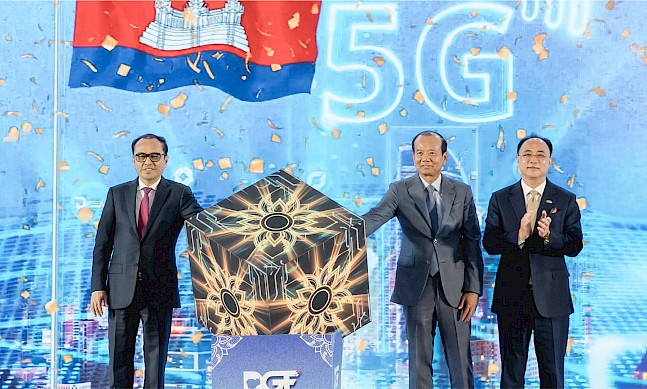
As the port authority, alongside the Ministry of Public Works and Transport, we are also studying connectivity, both internet and logistics, to reduce costs and ensure nationwide integration. With support from the Prime Minister, all directions now connect to our port.
As our port reaches scale, it will complement Vietnam and Thailand. In the future, Cambodia may use ports like Vietnam’s and Laem Chabang, while they may also use ours. This cooperation will reduce costs and create shared benefits for all.
Training 1.5 million workers is essential for the future. I recently read the Prime Minister’s letter emphasizing once more that education, human resources, peace and stability are vital.
We are also developing a green port with Japanese support, following international regulations and training our staff. The port employs 1,400 workers. Although our current capacity is 1 million TEU, this year we may handle 1.2 million, and next year 1.5 million, exceeding design limits. I thank our port workers for their dedication to efficiency, cleanliness and predictability. In port operations, quality and time are critical, as time is money.
We also thank our Minister and both our current and former Prime Ministers for their strong support. Port investment has been highly efficient. With less than $1 billion across three phases, we are creating global connectivity, reducing ocean freight costs and saving time. Previously, shipments from Europe had to stop in Singapore before reaching Cambodia, adding cost and delay. Now, direct calls will change that.
Q: How did container infrastructure evolve in the early years?
LKC: Japan helped develop the 400-meter container port. We first installed two cranes, then purchased two more from China’s ZPMC and later two from Maersk. Now we have a total of seven cranes, all very busy. The Prime Minister once noted that unlike in other ports, where cranes often stand idle, ours are always working. He joked that cranes here are never at rest.
This port is Cambodia’s port, but under the Prime Minister’s policy, it belongs to everyone. We welcome all partners to work and cooperate with us. If they need something, we adapt and collaborate. Our goal is to make this a small but high-quality port, reliable, predictable and efficient. That is what matters most.
Q: What leadership lessons shaped your approach over time?
LKC: First, I follow the instructions of our former Prime Minister. Second, the current Prime Minister’s key policy is that the port belongs to everyone. We tell shipping lines, “This port is yours. If you need improvements that benefit both you and us, let us know.” We welcome feedback from lines like Maersk and others.
We also learn from our Japanese partners and from Singapore, which trained our port staff. I myself trained in Singapore, Antwerp in Belgium, New Zealand’s Auckland port, Korea and Japan, gaining experience in port management. Our staff continue to learn abroad as well.
Most importantly, we operate with flexibility. The port belongs to shipping lines, trucking companies and everyone who relies on it. If they need changes, we adapt to make operations efficient and acceptable for all.
When Maersk first began container operations here, we lacked specialized cranes and had to use general cargo cranes, creating many challenges. But we worked and learned together, and that transformed the port.
Q: What are your priorities looking ahead?
LKC: First, we have strong support from our head of state. Second, we understand our obligations. The port must reduce logistics costs. Since ocean freight is the largest portion, lowering these costs increases Cambodia’s trade competitiveness, attracts investment, creates jobs and reduces poverty. This port is built to benefit everyone.
Former Japanese Prime Minister Fumio Kishida and our former Prime Minister shared the vision of developing this port as a main gateway for the Mekong subregion, serving all people in the region. By 2027, Cambodia will change significantly, and by 2030 even more so, not only for our country but also for neighbors like Vietnam.
I am proud to work for my leaders, my Cambodian people and people around the world. We tell shipping lines, if you have any problems, let us know. This port belongs not just to us but to you. We work together with open minds for the benefit of all.