






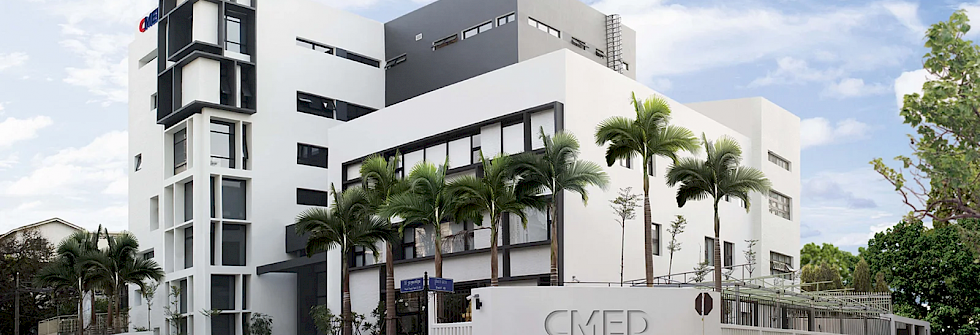
CMED Group is a diversified Cambodian enterprise operating across construction, mobility, retail and manufacturing – building systems with long-term clarity that are aligned with Cambodia’s future. Founded on principles of trust, innovation and national contribution, CMED has expanded across construction, mobility, retail and local manufacturing. Today, its core businesses span high-rise construction, Honda car and motorcycle distribution, ISUZU vehicle distribution, Hitachi elevators, Komatsu heavy machinery and kitchen appliances.
While each business operates independently, all share one standard: build with clarity, discipline and long-term usefulness. CMED continues to invest in Cambodian talent, digital infrastructure and future-driven systems such as AI and green construction. Deputy CEO Jenny Chea Sok You outlines CMED’s evolution and her system-driven vision for Cambodia’s next generation of industries.
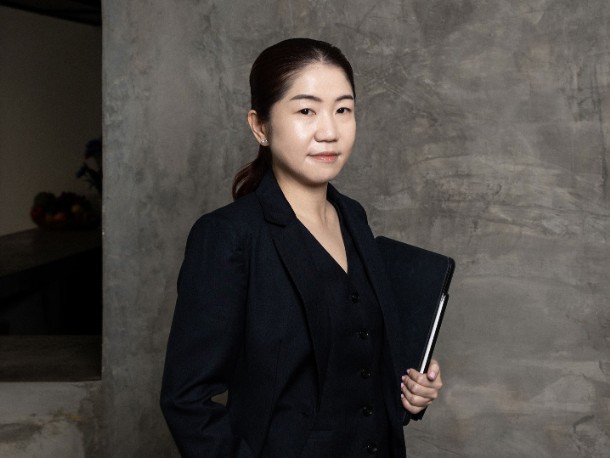
“Throughout the process, we integrate technology to improve understanding and accelerate progress”
Jenny Chea Sok You Deputy CEO
Post ThisQ: What is your vision for the company?
Jenny Chea Sok You, Deputy CEO: I am purely the designer and contractor, not the landowner. Throughout the process, we integrate technology to improve understanding and accelerate progress. On-site, we do not just show basic drawings, we use 3D models for subcontractors. Many workers struggle to interpret 2D drawings, but 3D visualization makes it clear. This integration reduces errors and waste, which are costly in construction.
Every dollar charged to clients or contractors must be justified, so we control the entire process. During construction, live 3D models are always available on our platform, updated in real time. Any change can be spotted immediately. For example, with the GDT building and its sky bar, stakeholders could access the platform, explore the design and experience the concept directly. It is a mixed-use building designed to function as a self-sustaining ecosystem.
Technology integration ensures decisions are clear and cost-effective. A wrong or unclear decision results in financial loss. We work closely with clients to align with their vision. For instance, one project featured a modern design, while another, a financial headquarters, had a classical style. The outcome depends on client preferences. Ultimately, it is about delivering the best user experience, tailored to their goals and aesthetic choices.
Hattha Bank, owned by MUFG illustrates this process. We first worked with the local Hattha team, then aligned with higher levels. The project took three years, covering both design and construction, not just construction time.
Q: How are you contributing to the country’s national strategy?
JCSY: For us, the Pentagon strategy is not theory; it is applied in our daily operations.
Within CMED Group, we operate across multiple sectors and invest in speed, precision and digital systems to elevate infrastructure building and design. This is evident on the ground. For example, in construction we currently achieve a seven-day-per-floor cycle, with full documentation to prove it.
Our team is trained to stay ahead, building systems that last rather than focusing only on completion. Even after delivery, we prioritize customer care, ensuring no complaint goes unheard. This applies not just to buildings but across all our business units, including motorcycles and other products. Feedback is essential to our learning and improvement.
Whether in public or private developments, we address real structural problems and coordinate solutions that impact national progress, investor confidence and user trust. In doing so, we build stability across every layer of execution. This is how we bring the Pentagon strategy to life.
Q: What differentiates your group from other companies in Cambodia?
JCSY: My father built CMED from the ground up, not just as a business but as a statement of what a Cambodian company can achieve. His passion was to show what is possible when courage meets discipline. I learned from him not by watching his wins, but by observing how he overcame challenges.
Our group philosophy comes directly from him: trust, innovation and contribution to society. These are not slogans but guiding principles, passed down as the foundation of our company. Every project and business we pursue must embody all three values.
What sets us apart is turning this foundation into a system. We operate fully integrated across design, business units and delivery, solving problems before they cause delays. We train our people to think long-term, measure execution by real impact rather than volume and scale with control, not recklessness. These three principles continue to guide and sustain us.
Q: How is innovation central to your growth strategy?
JCSY: For us, innovation must keep us in control, that is the point. It is not just a tool or something fancy to own. We use technology to surface real problems, improve communication and identify root causes, which are often harder to find than the problems themselves.
Our systems, e-systems and overall operations are designed to address real issues, not just paperwork. Paper alone does not deliver products or services to end users. True innovation means making processes faster, improving quality, strengthening management and control, and enhancing outcomes.
Innovation at CMED is not only about systems but also about management evolving around these principles. Machinery upgrades and technology improvements are part of this larger approach.
Q: Where are the key opportunities for foreign collaboration with your group?
JCSY: We welcome partners who value clarity, speed and sovereignty. Our interest goes beyond capital. We seek alignment with true builders. In our construction-related unit, which I manage, we work with dedicated partners who handle much of the model business.
Looking ahead, we are focused on real estate development, clean energy integration, advanced prefabrication, digital infrastructure and smart building management. These sectors will shape Cambodia’s physical future, and the right partners can join this momentum with real experience, skilled infrastructure and next-generation construction technology.
Our goal is to move fast while building to last. We want partners who can co-design with us, perform under pressure and deliver real services that strengthen Cambodia.
“Cambodia has abundant opportunities, land, resources and potential, but we need real, high-quality buildings to unlock them.”Post This
Q: How is your company promoting ESG?
JCSY: For us, ESG is fully integrated; it runs in parallel with our operations. As a woman leader, I believe leadership should not be about promotion or labels, but about clarity, trust, performance and responsibility. We promote based on real capacity, and we invest in training young local builders, many of them fresh graduates. We give them systems, guidance and opportunities to grow. We also support local entrepreneurs and vendors, who bring the hunger and drive we value, and we hire from within our communities. Every decision is linked to national strategy, making ESG more than a promise, it is embedded in how we build, lead and scale with real impact.
Trust is our first and hardest principle. To succeed, we must earn trust from clients, employees, vendors and communities, especially since construction carries risks and disruptions. Trust requires continuous effort and commitment.
What makes me proud is not just delivering buildings, but seeing users feel a sense of belonging. We do not rely on marketing. Our real marketing is the product itself and the word of mouth it generates. That is why we remain less visible, but highly trusted.
We chose to share our perspective now because we believe in presenting Cambodia to the world the right way. My father and I both want to give the correct perception: that Cambodia values peace. As a generation after the war, we never take peace for granted. For us, peace is not just a condition but a responsibility. It is the structure that holds everything together.
Q: What are your top expansion priorities for the next 3–5 years?
JCSY: We will continue to scale our credit-based construction model, expand digital integration and explore how AI can solve real challenges. We are also enhancing prefabrication and material control systems, including green and high-performance materials that improve speed and quality.
Looking ahead, we are planning the CMED Tower, our vision for a next-generation ecosystem. It will not be just a building, but an integrated hub designed to operate as part of a larger ecosystem. This is the first time I have spoken about it publicly, and we will decide later how to present it.
Beyond construction, we are developing our appliance business. We represent global brands such as Bosch and Beko, and we are building a one-stop shop with a showroom and design center where users can plan integrated kitchens, bathrooms and bedrooms. This marks our next chapter of growth.
CMED itself carries meaning. “C” is for Chea Huy, our chairman. “M” is for motor, where his business began with cars and motorcycles. “E” is for electronics, where my mother built her business in kitchen appliances starting in the 1990s. “D” is for development, our future. Together, this reflects the company’s evolution and identity.
My father worked in Vietnam in the 1980s, distributing Honda, before returning to Cambodia in 1999. I was born in Cambodia but lived abroad due to the civil war, two and a half years in Vietnam, then ten years in Singapore and six years in the U.S. When I returned, architecture was barely recognized. Contractors built homes without architects, and the profession was not understood.
One of my first clients dismissed me, saying, “I don’t need a book to build a building; I only need one piece of paper.” At that time, few architects were registered in Cambodia. We had to introduce and prove the value of design through 3D, plans, sections, elevations and concepts. Over 15 years, that perception has transformed. Today, everyone recognizes the need for architects.
Cambodia has abundant opportunities, land, resources and potential, but we need real, high-quality buildings to unlock them. Starting slow has been an advantage: it allowed us to build carefully and position ourselves strongly for the future.
Q: What leadership lessons have you learned since returning to Cambodia and helping people understand the role of an architect?
JCSY: My U.S. education gave me technical skills and an architecture degree, but what shaped my leadership was facing challenges. When I returned home, I saw gaps across architecture, construction and appliances. Each gap pushed me to find solutions, which led me from design to full execution.
Construction became necessary because I could not rely on external builders to deliver our design intent. Ten years ago, we could create beautiful drawings and 3D models, but no builder could fully translate them. Without proper execution, design loses its value. Clients also sometimes abandoned projects after one or two years of design work, wasting the most valuable resource, time. That drove me to ensure our projects move from design to completion, so the work is lived and experienced, not left on paper.
I believe problems are power, the bigger the problem, the bigger the opportunity. Growth comes not from avoiding difficulty, but from confronting it and building new solutions. That is why I lead through systems shaped by both pressure and passion. The hardest part is not finding solutions but uncovering the real problem, which is often hidden beneath layers.
This is where technology and AI help. They do not replace people but surface problems faster in a data-based format, reducing time to solutions. We are developing systems at the data level to cut down repetitive processes like documentation. Documentation remains essential for audits and decision-making, but it consumes too much time. Our digital systems streamline approval and control, freeing architects to focus on design and engineers to spend more time on-site ensuring quality, instead of being stuck behind desks writing reports.
This efficiency is why we can deliver buildings in three and a half years. Innovation for us is not about being loud or flashy, but about addressing real problems effectively. As my father taught me, trust, innovation and contribution to society must be embedded in our systems. Innovation is meaningful only when it creates real solutions, not just tools that look impressive.
Q: Do you plan to go public?
JCSY: We do not seek outside funding at this time. For us, scaling must come with control. That is why we invest so heavily in our digital platform to scale while maintaining oversight. It is easy to sign up for partners, but without a deep understanding of the product and service, growth is unsustainable. With big brands, control often slips away, and that is not acceptable for us.
Within our group, manufacturing generates more revenue than construction, particularly from motorcycles. However, our focus remains domestic; we have not exported bikes yet.