







Jasa Marga manages one of Southeast Asia’s largest toll road networks, operating critical highway infrastructure that supports mobility, logistics and industrial development across Indonesia. The company continues to demonstrate its resilience and leadership in the national toll road industry, recording solid growth in its financial and operational performance throughout the first half of 2026. During this period, Jasa Marga successfully posted operating revenue of IDR 10.3 trillion, a 7.6 percent increase compared to the same period the previous year. The company’s operating revenue was driven by toll revenue of IDR 9.5 trillion and other operating revenue of IDR 798.2 billion, increases of 6.8 percent and 17.6 percent, respectively, compared with the same period the previous year.
Revenue growth, coupled with measured operational optimization, drove the company's EBITDA to IDR 7.0 trillion—an 8.1 percent increase year-on-year—while maintaining an EBITDA margin of 67.8 percent. This EBITDA performance strengthens the company's capacity to generate robust cash flow to meet its financial obligations while continuing to support its investment and business expansion agenda. This growth is also reflected in Jasa Marga's profitability, with net profit attributable to owners of the parent entity reaching IDR 1.9 trillion—representing a 2.0 percent increase compared to the same period the previous year.
Under President Director Rivan Achmad Purwantono, the company is moving beyond road construction toward a broader model that places technology and customer experience at the heart of the business, supported by a new app that feeds data into decision-making. In this interview, Purwantono explains how the company is transforming toll roads into an “infraculture” platform for connectivity, investment and national competitiveness.

“The opportunity is not just to build roads; it is to build connectivity and behavior simultaneously.”
Rivan Achmad Purwantono President Director, Jasa Marga
Post ThisQ: How is Jasa Marga moving beyond physical infrastructure?
Rivan Achmad Purwantono, President Director of Jasa Marga: When I took on this assignment, I saw immediately what was missing. Jasa Marga is about infrastructure—but infrastructure alone is not enough. We are moving toward something broader, which I call "infraculture". With 1.3 billion vehicle passages annually across our network, the opportunity is not just to build roads; it is to build connectivity and behavior simultaneously.
Our customers have a culture of their own, and right now, when someone enters one of our toll roads, they do not feel any particular relationship with the space they are traveling through. There is no differentiated value. That is the paradigm we must shift. “Infraculture” means we are not simply preparing a physical road—we are shaping the experience of using it.
Q: How does technology support this cultural shift?
RAP: Technology is the instrument that forces cultural change. Systems designed in the U.S. or the U.K. are built to reshape behavior—Indonesia has not yet had that kind of forcing mechanism. We are changing that.
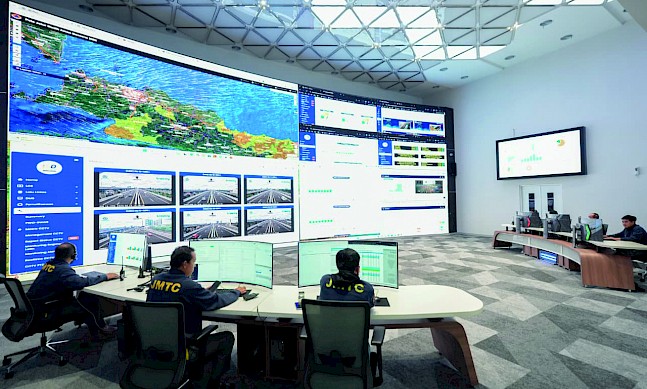
Jasa Marga now operates the most advanced command center in Indonesia. Our Intelligent Transport System manages 1,294 kilometers of road with 3,500 cameras—not passive cameras, but smart cameras with intelligent traffic analysis capable of calculating accuracy levels in real time. We do not simply take traffic as a given; we create and control it. During peak holiday periods such as Lebaran, the command center drives all key decisions on contraflow and one-way traffic systems. The Indonesian Police and the Ministry of Transportation now use us as a reference point.
We have also deployed RFID reader technology to identify truck owners and logistics operators, as well as weigh-in-motion sensors to address the over-dimension and overload problem that shortens road life. Trucks account for only 12 percent of our traffic but are responsible for 84 percent of accident impact. Addressing that is not just an infrastructure challenge—it is a cultural one, and technology is how we solve it.

Q: How has the launch of Travoy improved the user experience?
RAP: Travoy is our proprietary traffic and services application, and it goes well beyond conventional navigation. During the last Lebaran period alone, it recorded more than 26,000 transactions per day from daily active users. The application streams live camera feeds so users can see road conditions in real time—more responsive and accurate than any third-party mapping tool, because it draws directly from our own system.
It also includes roadside assistance, towing services, incident alerts and information on accident-prone zones, as well as information on rest area location, parking availability and e-toll top-up services. We are developing predictive recommendations so that if you input a destination, Travoy will suggest the optimal departure time based on known traffic patterns. Beyond the user experience, Travoy creates financial value: when people feel informed and comfortable, they use the road more. Usage data also allows us to build targeted programs for customers in partnership with banks and other platforms. Mandiri and BCA are already working with us.
We have also integrated Travoy with radio through a collaboration with Sonora—not by acquiring a radio station, but by embedding a streaming and podcast function directly into the app. A driver traveling from Jakarta to Surabaya no longer needs to switch frequencies. It is a small detail, but it is exactly the kind of experience that changes how people relate to the road.
Q: What is Jasa Marga’s investment case today?
RAP: We currently manage 1,294 kilometers, but there is a meaningful gap—Java still needs significantly more toll road connectivity, and we are well-positioned to develop it. More importantly, toll roads in Indonesia are no longer purely about moving vehicles. They are catalysts for industrial development. Investors looking at Indonesia understand that logistics speed and security improve dramatically on toll roads compared to national roads, and that creates a compelling case for industrial area development alongside highway infrastructure.
We are actively looking for partners to co-develop our technology capabilities. The RFID payment transformation—moving from card-based to server-based payment systems like those in the U.K. and the U.S.—requires international benchmarking and collaboration. Our data infrastructure, logistics tracking capabilities, and the Travoy platform all represent partnership opportunities with real commercial upside.
Malaysia has already come to Jasa Marga to learn from our rest area management model. We are transforming rest areas from functional stops into curated destinations under the Rasa Nusantara brand. Investors are beginning to compare us not just within Indonesia but across the region, and that comparison reflects well on us.
Q: How do you lead transformation at Jasa Marga?
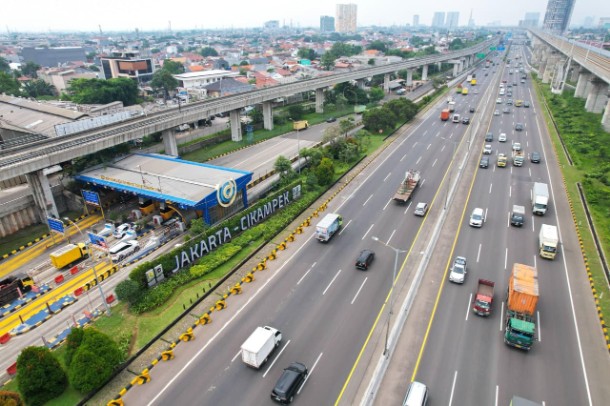
RAP: This is my third CEO role, but the largest and most consequential. The scale of daily impact is unlike anything I have managed before—3.5 million vehicle passages per day on the Jakarta–Cikampek corridor alone. That demands a different kind of discipline.
My banking background—26 years—shaped how I think about financial fundamentals and operational governance. A company cannot serve the public if its financial foundation is not strong. At Jasa Marga, I have applied that lens to create new regulations, clearer SOPs and a financial vision that aligns directly with our service mandate. There is no gap between those two goals.
I also came with a track record of executing transformations that seemed difficult. At a previous role, I moved electricity payments from manual to digital. At Jasa Raharja, I recommended changing vehicle license plates from black to white—a small design change with significant implications for tax compliance visibility. I believe in measurable, achievable stages of transformation, not slogans. My office has no partitions. I have 16 young transformation leaders embedded in the business. Every policy we set must be felt at every level of the company, because transformation is ultimately about execution, not planning.