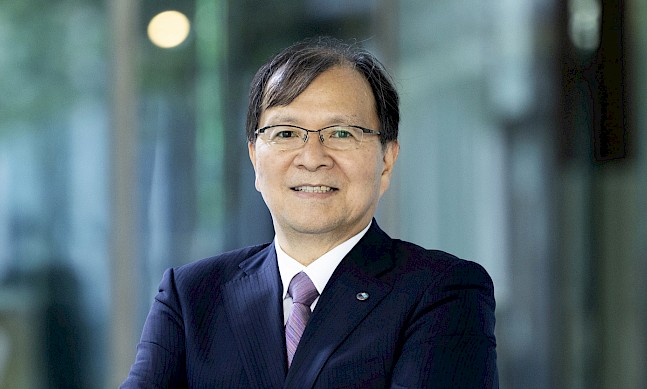








After three decades in which productivity gains failed to reach workers’ paychecks, Japan is seeing real wages rise and deflation give way to inflation. For the small and medium-sized enterprises (SMEs) that anchor the nation’s regional economies, the shift brings new challenges around costs, succession, and technology, as well as opportunities abroad. One of the figures representing those businesses is Ken Kobayashi, Chairman of the Japan Chamber of Commerce and Industry (JCCI). In an exclusive interview, Chairman Kobayashi discusses supply chain partnerships, business succession, and Japan–U.S. investment ties.
“My message to G20 leaders is straightforward: the global economy functions best when countries engage openly and in good faith with one another.”Post This
Q: Where does Japan's economy stand today, and how does that shape your priorities?
Japan's economy is at a genuine turning point, and understanding where we stand today requires looking back at the previous three decades. After the asset bubble collapsed in the early 1990s, Japan entered a prolonged period of stagnation that lasted roughly 30 years. GDP growth was minimal, and while productivity did increase over that period, the critical failure was that none of those gains translated into wage growth.
The consequence of that dynamic was significant. The fruits of three decades of productivity growth were absorbed entirely by corporate balance sheets, large companies and SMEs alike, rather than being passed on to workers. That is the structural problem I inherited when I began this role.
When I took office in late 2022, the COVID-19 pandemic was still winding down and economic activity remained suppressed. Since then, the government has shifted economic policy substantially, and we worked together with the cabinet on an economic stimulus plan specifically designed to support SMEs. The results are beginning to show. Real wages are now rising, and Japan has moved from deflation into inflation. Managing that inflation, keeping it close to the 2% target, is now the central challenge, much as it is in the United States and elsewhere. At the same time, Japan has no domestic energy resources, no oil, no coal, no gas, so we remain highly exposed to external price volatility and to currency movements. The weakening yen has compounded inflationary pressures, and restoring market confidence in the currency is a priority.
Q: What are some of the key initiatives under your leadership?
When I took on this role, we introduced what we call the Partnership Building Declaration, a written commitment by company CEOs, large and small, to pursue co-innovation together and to engage constructively with subsidiaries on wage increases and materials price hikes. The idea was to formalize a new understanding across the supply chain: that mutual benefit, not one-sided dependency, is the foundation for sustainable growth.
On the enforcement side, the Japan Fair Trade Commission monitors compliance and takes action where larger companies are found to be pressuring their supply chain partners unfairly. The media also plays a role in holding companies to account.
The deeper challenge is cultural. There is still a strong hesitation on the part of smaller companies to make any claim on the parent company, even when cost pressures are clearly justified. Changing that mindset takes time. But the direction is clear, and I believe this initiative will stand as one of the defining contributions of my time in this role.
Q: Business succession is another priority you have identified. Why is it so urgent, and what is being done to address it?
Japan experienced a significant baby boomer generation born in the years immediately after the Second World War. Those individuals are now reaching their mid-seventies or older, and the majority of Japan's family-owned SMEs are currently managed by founders or first-generation owners of that age. At the same time, Japan's population has declined considerably, and the pool of family members available to take over these businesses is much smaller than it once was.
In many cases, an 80-year-old founder is still running the business with no clear path forward. If these businesses close rather than transition, the consequences extend well beyond the individual company. In regional areas especially, SMEs form the backbone of the local commercial infrastructure—the shops, restaurants, service providers, and small manufacturers that give communities their economic vitality. Losing them is not simply a business issue; it is a question of regional sustainability.
We are pressing the government on a range of policy responses, including inheritance tax reform, to make succession economically viable and attractive. We are also encouraging a broader cultural shift, recommending that the next generation see taking over a family business not as a burden but as an opportunity, one that can be expanded through M&A and partnership with other companies of a similar scale. This can make entrepreneurship a credible and rewarding path.
Q: How are you helping SMEs with digital transformation and AI?
This is one of the most pressing practical challenges we face. The owners of many regional SMEs are, frankly, of an analog generation. They are not naturally inclined toward digital transformation, and the concept of AI-driven efficiency can feel abstract and remote. The key to reaching them, we have found, is to make the business case in the most direct terms possible: if you introduce AI, you can reduce costs and you can make more money. When the connection between technology and profit is clear, adoption follows.
The entry point for many SMEs is energy saving and reduction of working hours, both of which translate directly to the bottom line. From there, the scope of digital transformation can expand. But the deeper structural enabler is succession. When younger leadership takes over, the openness to technology tends to follow naturally. That is why business succession and digital transformation are, in many ways, two sides of the same challenge.
Q: How will Japan’s recent commitment to investment in the United States shape relations?
Japan's commitment to the United States is substantial, and that investment will generate commercial momentum in both directions. Large Japanese companies and their supply chains will deepen their presence in the U.S. market, and SMEs with niche specializations will have opportunities to follow.
At the same time, we strongly welcome U.S. investment in Japan. The case for Japan as an investment destination rests on a combination of factors that are difficult to replicate elsewhere. We are a stable, safe, and highly organized society. The quality of life, the infrastructure, and the rule of law are consistently reliable. Japan's specialty industries, from advanced manufacturing and semiconductors to content and creative industries such as animation and digital media, represent genuine areas of competitive strength. Many of these sectors are populated by SMEs with deep technical expertise and a premium, traceable quality that resonates strongly in global markets.
We are also encouraging Japanese companies, including in the service and consumer sectors, to look outward more actively. Premium Japanese products with strong heritage and authenticity have already demonstrated their appeal in markets across Asia. The same opportunity exists in the United States. The growth in awareness of Japanese cultural exports is real, and there is significant commercial potential to be captured.
Q: What is your message to political and business leaders ahead of the G20 summit?
The companies we represent are among the most directly affected by the divisions and disruptions shaping the world today. Tariffs, protectionism, supply chain disruption, and geopolitical uncertainty do not affect abstractions; they affect real businesses, real workers, and real communities. That is the perspective I bring to these conversations.
My message to G20 leaders is straightforward: the global economy functions best when countries engage openly and in good faith with one another. Protectionism may appear to offer short-term advantages, but it imposes real costs on the businesses and workers it is meant to protect. Cooperation, by contrast, creates the conditions for mutual growth. That principle is not idealistic; it is pragmatic. And it is the principle on which durable economic progress is built.