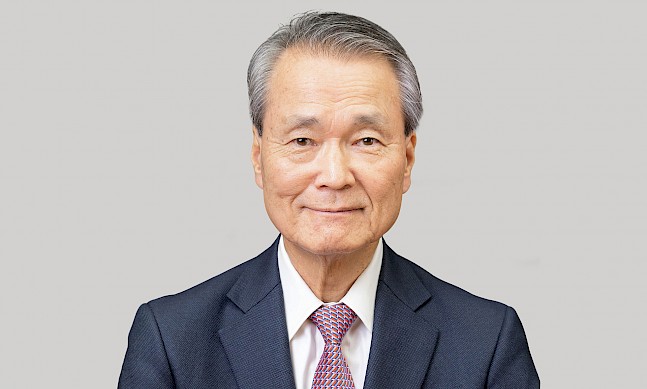








For much of the period since Japan’s asset bubble burst, corporate strategy centered on cutting back. Companies worked to unwind what became known as the three excesses—in capital equipment, employment, and debt—that had built up during the bubble era. Investment was scarce, wages did not rise, and the economy entered what Yoshinobu Tsutsui, Chairman of the Japan Business Federation (Keidanren), calls “an era of contraction.”
Chairman Tsutsui, who took office as Japan was beginning to emerge from deflation, has made changing that pattern his foremost priority. “I believe we need to make a major shift—to change the structure so that, by making investment, we drive the circulation of the economy,” Mr. Tsutsui says.
He calls the concept the “investment-driven economy,” built on three types of spending: capital equipment, research and development (R&D), and people, including wages. “I want to shift corporate leaders’ mindsets so that they actively pursue all three,” he says.
“Even if something may not directly lead to short-term corporate earnings, as long as it broadly contributes to solving social issues, the business community will actively commit to it”
Chairman Japan Business Federation (Keidanren)
Post ThisKeidanren has set long-term targets for private-sector capital investment and for combined public and private R&D spending, and has urged the government to back them through the national budget, the tax system, and regulatory reform. “We are now moving together, public and private as one, toward these targets,” Mr. Tsutsui says. He sees Japan following an international trend in which governments take the lead on national and economic security, creating the incentive for private investment to follow. “Japan is now walking along that same path,” he adds.
Taking a long view has been part of Keidanren’s philosophy since its founding. Its members are companies, but the federation is not solely focused on business. “Even if something may not directly lead to short-term corporate earnings, as long as it broadly contributes to solving social issues, the business community will actively commit to it,” Mr. Tsutsui says. That includes issues such as climate change, the collapse of ecosystems, and inequality. “By committing firmly to these issues and helping to determine the direction of resolution for society as a whole, companies can also realize long-term business value,” he adds.

Talent Behind the Investment
For Chairman Tsutsui, the biggest obstacle to boosting Japan’s growth rate is the labor shortage. The country’s population, including its working-age population, has entered a phase of decline that is expected to continue. “So even if we want to invest, the human resources needed to carry that investment forward are gradually falling short,” he says.
Keidanren’s strategy to address this centers on maintaining the momentum of wage increases strongly, continuously, and over the long term. Says Mr. Tsutsui: “Sustained wage growth is central to attracting and retaining the talent that investment-driven growth requires.”
A Science and Technology Nation
Keidanren’s FUTURE DESIGN 2040 road map sets out a vision of Japan as a science and technology-oriented nation, an idea that began under Chairman Tsutsui’s predecessor and one he has carried forward. Soon after taking office, he launched a special committee on the subject, which has since submitted its recommendations to the prime minister.
At the heart of this is Japan’s research capability. “Japan has fortunately continued to produce Nobel laureates, but the Nobel Prize recognizes work achieved 20 to 30 years ago,” Mr. Tsutsui says. “We need to ensure there is always a pipeline of future researchers doing the foundational work today.”
The committee’s recommendations call for the whole process—from basic research to innovation, commercialization, and deployment across society—to advance in one seamless flow. Keidanren has asked the government to increase its R&D budget, direct more resources to universities, and press ahead with regulatory reform. It has also recommended creating a ministry of science and technology to bring policy now spread across several ministries and agencies under a single portfolio.
Chairman Tsutsui says ties between Japanese companies and universities remain considerably weaker than in the United States, and Keidanren has called for the university budget to at least double. “What I would like to create is a world where people from both sides intermingle and truly fuse together,” he adds.
Looking to 2050
As Keidanren marks its 80th anniversary, Chairman Tsutsui sees it as the right moment to look further ahead. His goal is to build a vision for 2050, when today’s younger generations will be in leadership roles. “What kind of economic society will Japan be in 2050, and what should it be—that is what I would like to envision seriously,” he says.
Population decline, a concern across Japan, will shape that vision. Mr. Tsutsui singles out two priorities: to mitigate the pace of decline by addressing the falling birth rate, and to strengthen education. “Even with a smaller population, we can cultivate top-notch talent,” he says. The vision will also cover social security, the revitalization of regional economies, policies on foreign workers, and the extent to which AI will have permeated society—and the proactive role companies can play in shaping it. “After all, companies are always the main protagonists of the economy,” Mr. Tsutsui says.