






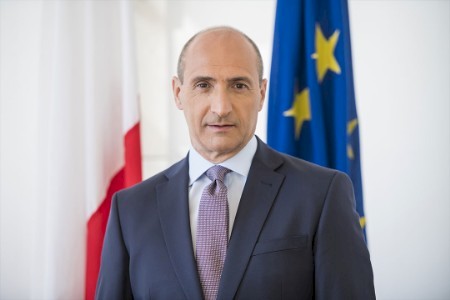
Appointed Minister for Foreign and European Affairs and Trade in June 2026, Christopher Fearne brings nearly a decade of senior cabinet experience to the role. Here, he explains why Malta is a bridge between Europe and the wider Mediterranean, and why UK businesses should look to the island as their base inside the European Union.
Q: What is your vision for Malta’s foreign policy?
We firmly believe in the rules-based international order and we continue to advocate for it – not only by holding ourselves to those standards, but by supporting like-minded countries in working to restore civility within the international community. Within that framework, our foreign policy unashamedly advances what is beneficial to Malta and to Maltese people, both at home and abroad. That is no different from any other country in the world.
In short, our foreign policy is European, Mediterranean, grounded in Maltese interests, guided by neutrality and anchored in the rules-based international order.
Q: How does Malta’s Mediterranean identity shape its outlook?
We are solidly Mediterranean – not only geographically, but in culture, values and vision. We are part of the European Union and part of the Schengen area. But as strongly as we identify as European, we are equally Mediterranean. Geographically, we may sit at the edge of the European Union, but we are at the centre of the Mediterranean.
The Mediterranean should not remain a barrier between Europe and Africa. It should be a bridge, and our foreign policy has long been oriented towards building a more integrated Mediterranean region.
Q: What role does neutrality play in Malta’s diplomacy?
We are constitutionally a neutral country. Even as a small state, Malta is never perceived as a threat to anyone. Our neutrality gives us the opportunity to present ourselves as mediators in geopolitical conflicts. Much of this work happens behind the scenes.
Q: How has EU membership shaped Malta’s economy?
The Maltese experience within the European Union has been a positive one. Our economy has practically doubled since we joined over 22 years ago, and it continues to grow at pace. Tourism remains an important pillar, alongside financial services and ancillary services.
This rate of growth is not a fluke. It has been sustained over a number of years.
“Being a small country is actually an advantage. We are agile and flexible – not in our regulatory standards, but in the way we make foreign investment work.”Post This
Q: How is the Ministry supporting Maltese businesses abroad?
The time has now come – and this is already beginning to happen – for Maltese companies to expand beyond our shores, to look not just at the domestic market but to reach outward. The role of the Foreign Ministry – with our network of embassies, ambassadors, diplomats and consuls around the globe – is to facilitate this.
It is to make it easier for Maltese businesses to operate abroad, to ensure they are working within the legal frameworks of host countries and, critically, to help them partner with foreign investors and companies, including those from the UK. Joint ventures between Maltese and foreign companies are something we are actively working to encourage and expand.
Q: What can Malta offer UK investors?
Malta has always maintained a strong relationship with the UK. It has evolved over time – from a colonial relationship, to equal partners within the European Union, and now to a friendship between an EU member state and a country outside the Union that is increasingly looking to strengthen its ties with Europe.
Malta offers more than simply a connection between the UK and an EU member state. We are English-speaking. A great deal of our traditional commerce has been conducted with the UK, so person-to-person and business-to-business relationships go back decades. We have a strong regulatory framework, a robust financial services sector, a well-educated and English-speaking workforce and a geographic position that faces not just Europe but North Africa and the Middle East as well.
Q: Why should UK companies use Malta as a base?
Investing in Malta, establishing offices or production facilities here, means that products become EU products. Coming through Malta makes that possible.
We are also developing a policy of building joint ventures between Maltese and foreign companies, not simply to invest in Malta, but to use Malta as a base for expansion into the Middle East and Africa – not only North Africa, but Sub-Saharan Africa as well. The possibilities there are almost endless.
Q: What makes Malta’s investment environment attractive?
Malta remains a politically stable country. Even when political transitions occur, they are seamless, conducted in a civilised and democratic fashion without disrupting the economic environment. There is also cross-party agreement on foreign direct investment, regulatory frameworks and financial policy. For investors, the predictability this provides is precisely what they are looking for.
What I would emphasise is that being a small country is actually an advantage. We are agile and flexible, not in our regulatory standards, but in the way we make foreign investment work. The return on investment is good. Over the last 50 years or so, we have built a substantial part of our economy on FDI, which means we have the experience and the infrastructure to make it work.
Q: Where is the potential within the Commonwealth?
The Commonwealth is a supra-regional organisation, which makes it genuinely distinctive. Most international forums bring together countries by region. The Commonwealth does the opposite – it creates a platform for networking and partnership with member states across Africa, the Caribbean, the Pacific and beyond, countries that might not otherwise find it convenient to meet. The wider Commonwealth creates substantial opportunities for intra-Commonwealth trade.
As for the UK specifically, we have a long-standing commercial relationship that has diversified significantly over the years. Britain remains an important partner for us in trade, and that relationship continues to evolve.
Q: What do you hope to achieve as Foreign Minister?
Before entering politics, I was a paediatric surgeon. I spent a number of years studying, training and working in the UK, in Sheffield, Liverpool and then at Great Ormond Street in London.
In politics, it is not only the positions you hold that matter – it is what you leave behind. I am proud of the contribution I made to improving health services here in Malta. Now, as Foreign Minister, I have the opportunity to shape not only Maltese foreign policy, but also – as one of 27 EU foreign ministers – to contribute to shaping European foreign policy. That is both an opportunity and a real privilege. I look forward to continuing that work, and in particular to strengthening the Mediterranean dimension of Europe’s strategic outlook.